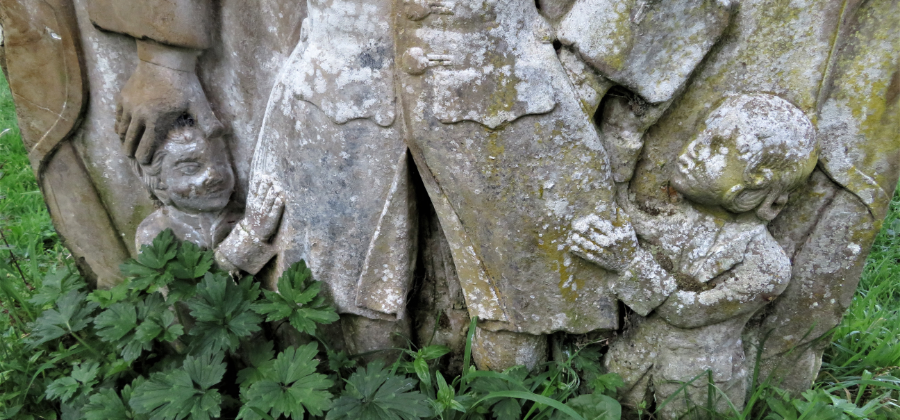
Temple Old Kirk's history
Temple Old Kirk is a late-medieval church built over the foundations of the Knights Templar Chapel at Balantrodoch. Located in a serene valley by the South Esk river, it stands as a testament to centuries of Scottish history and religious heritage. The history of the site has been thoroughly researched and written by John Kerry, TOKF's Secretary, bringing to light the remarkable stories of this historic site.
The Temple Old Kirk's connection to The Order of Knights Templar
The Order of Knights Templar was founded around 1120 by a group of French Knights, to safeguard the pilgrim routes to the 'Holy Land' in the aftermath of the 1st Crusade. King David 1 of Scotland granted the Knights Templar substantial lands beside the South Esk river, and they chose the site on which Temple Old Kirk now stands for their Scottish headquarters, which became known as Balantrodoch - 'The Settlement of the Warriors.'
In due course the Crusaders lost the battle for the Holy Land; the Knights Templar no longer had a justification for their existence, and their immense wealth became increasingly resented. A campaign against them was initiated by the French King Phillip II, supported both by the Pope and by Edward II of England. In the early years of the 14th century, the order was excommunicated, and in France many of their leaders were put to death. Their lands were confiscated, and transferred to the Order of Knights Hospitaller, who in Scotland administered them from their headquarters at Torphichen in West Lothian.
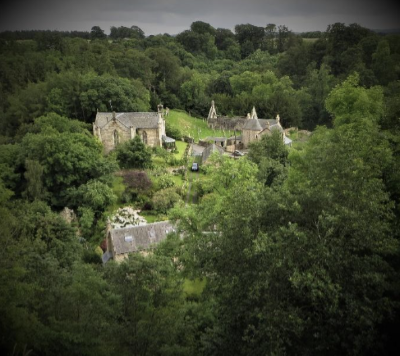
Temple Parish Church & the Reformation
The Chapel of the Knights Templar at Balantrodoch was pulled down, and the masonry used for the building of Temple Old Kirk, which was initially the chapel of the Knights Hospitaller, and subsequently became Temple Parish Church.
When the Reformation came to Scotland in 1560, the pulpit replaced the altar as the focus of the new religion. There was an embargo on the use of the Cross, which was seen to be idolatrous, but the more substantial relics of the old religion (such as the piscina and the sedilia) were permitted to remain, as their destruction would have threatened the fabric of the building. These features can still be seen at Temple Old Kirk, together with the tomb niche - which would probably have held the effigy of the member of the Knights Hospitaller who built Temple Old Kirk.
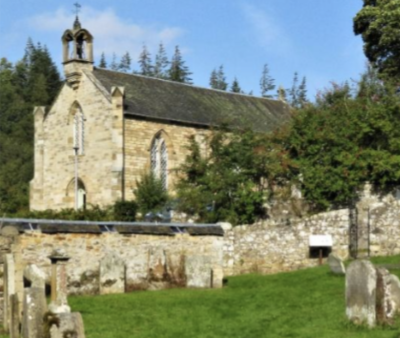
A picturesque ruin
Temple Old Kirk remained the Parish Church of Temple until 1832, when it was replaced by a new church just across the road at Shillinghill. Thereafter the Old Kirk subsided into a picturesque ruin. Robert Dundas of Arniston had the roof removed, for fear that it might be a danger to village children, who liked to play inside the building.
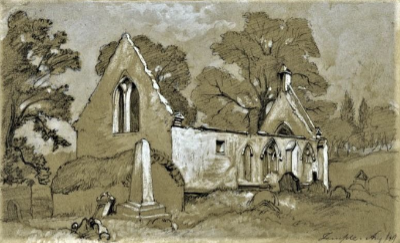
In 1849, James Ferguson did this drawing of Temple Old Kirk, which shows the roof already removed, and the obelisk - which had been erected just two years earlier in memory of the Minister, James Goldie - already in place.
If you'd like to find out more about the history of Temple Old Kirk, or review where we got our information, please read our blog Tracing the History of Temple Old Kirk: A Comprehensive Bibliography.